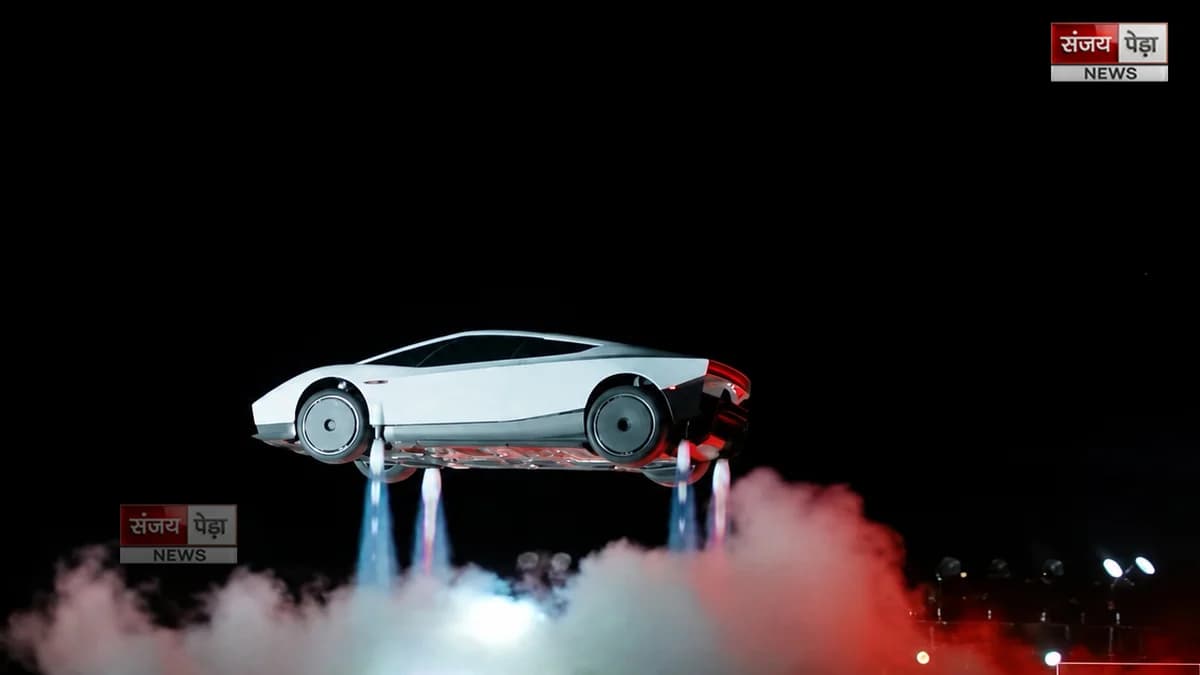
New Delhi, October 16, 2026: The idea of flying cars has taken a dramatic step towards reality after Elon Musk unveiled a redesigned version of Tesla’s next-generation Roadster, featuring rocket-inspired propulsion technology and the ability to perform brief aerial manoeuvres.
The demonstration took place on October 15 at SpaceX’s rocket testing facility in McGregor, Texas. The vehicle, developed through collaboration between Tesla and Musk’s aerospace company SpaceX, performed a series of unusual stunts that included travelling upside down along a specially designed ramp, flipping in mid-air and landing back on the ground.
The unveiling has attracted widespread attention, although the demonstration does not establish that the vehicle can operate as a conventional aircraft or travel between destinations through sustained flight.
Unlike conventional electric cars, the new Roadster features rocket-style thrusters designed to provide additional thrust and enable aerial manoeuvres.
During the event, Tesla’s Vice President of Vehicle Engineering, Lars Moravy, explained that a fan-based suction system helps the car remain attached to the specially designed ramp while travelling upside down. SpaceX-related technology is then used to perform the airborne stunts.
Musk described the system as having altitude-control thrusters and rear-mounted main thrusters, allowing the vehicle to perform manoeuvres similar to those of a rocket.
The demonstration also showed the car leaping over other vehicles. According to the company’s presentation, the Roadster is designed to combine extreme acceleration with advanced propulsion technology.
However, the public demonstration was conducted remotely for safety reasons. The displayed stunts should not be confused with proof of an aircraft capable of routine passenger transportation.
Tesla has presented the Roadster as a high-performance electric sports car with ambitious performance targets.
At the unveiling, the company said the vehicle could accelerate from zero to 60 mph in less than one second. Tesla also cited a driving range exceeding 300 miles on a single charge and a top speed above 230 mph for the Rocket configuration.
These are manufacturer-stated figures and should not be interpreted as independently verified production-car performance.
The Roadster project dates back to 2017, when Tesla first revealed plans for a next-generation version of its original electric sports car. The latest demonstration represents a major development in the project, which has faced repeated delays over the years.
Musk said Tesla expects to begin production of the redesigned Roadster in 2028. This is a production target, not a confirmed delivery date for customers.
Tesla has outlined different configurations, including Performance, Thrust and Rocket variants. The Rocket version is described as a single-seat model with a full flight system and is available by invitation, according to the company’s reservation information.
Importantly, Tesla’s stated restrictions mean the Rocket variant’s flight capability is not permitted on public roads. The precise regulatory requirements and practical limitations of its aerial operation remain important questions.
Tesla has not confirmed the final purchase price for the newly presented vehicle.
Its reservation information lists a $50,000 deposit for the Performance version and a $250,000 deposit for the Thrust version. These figures represent deposits, not the total purchase prices of the cars.
The Rocket configuration is listed as invitation-only. Prospective buyers will need to review the final specifications, pricing, availability and applicable restrictions before making a purchase decision.
Despite the excitement surrounding the unveiling, significant questions remain about whether the Roadster can evolve into a practical flying vehicle.
A car briefly leaving the ground during a controlled demonstration is different from an aircraft capable of sustained flight, carrying passengers safely and operating within aviation regulations.
Further details about flight duration, operating conditions, certification and real-world usability will be necessary before the technology can be considered suitable for everyday transportation.
For now, the Roadster is best understood as an ambitious electric sports car with demonstrated aerial-stunt capabilities rather than a commercially available flying car for routine travel.
The latest Roadster reveal highlights Tesla and SpaceX’s attempt to combine electric mobility with aerospace engineering. If the company meets its 2028 production target, the vehicle could become one of the most unusual additions to the high-performance electric-car market.
Whether its flying capabilities eventually move beyond controlled demonstrations remains to be seen. For consumers, the next major milestones will be production progress, final pricing, independent performance verification and regulatory approval.